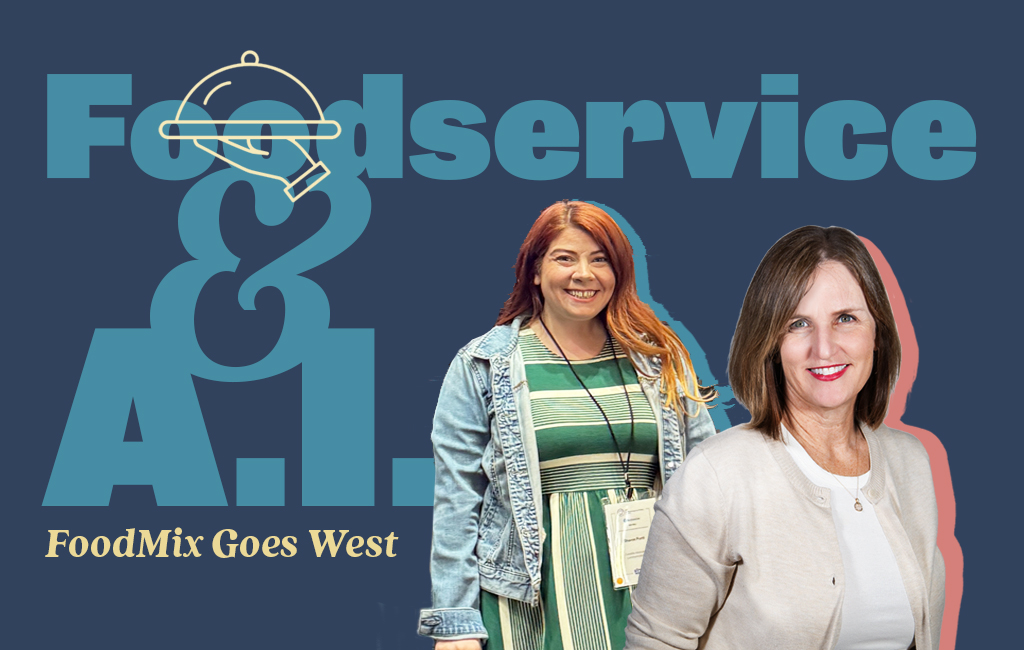
AI is dominating business conversations right now, but after attending Go2MarketEdge in Silicon Valley, one thing became clear: The real opportunity is not simply adopting more tools. It’s figuring out how to use them to solve meaningful problems for real people.
FoodMix attended Go2MarketEdge, hosted by IFMA The Food Away from Home Association, to better understand what AI could mean for our agency, our clients and the foodservice industry as a whole. Because the event was created for food-away-from-home leaders, the conversations stayed grounded in the realities of our industry, not just what the technology can do in theory.
We heard from leaders at Google, Amazon, and Plug and Play, who brought the future of AI to life through demonstrations of agents, data tools and new creative capabilities. But underneath all the technology, the most important lessons gained this week were surprisingly human.
Learning a new way of working rarely feels efficient at first. Sometimes you spend an hour trying to get an AI tool to complete a task you could have handled yourself in 15 minutes. But eventually, the process starts to click. You learn how to ask better questions of AI, where the tool is genuinely useful and when it can help you accomplish the same work in a fraction of the time.
The goal, however, is not to master every platform or force AI into every process. The more valuable skill is knowing when the technology can improve the work and when it cannot. That starts by defining the problem before choosing the tool. What decision are you trying to make? What would a better outcome look like?
Without that clarity, AI can help expedite what later turns out to be the wrong task. It can process information, but it cannot decide why that information matters.
You Cannot Outsource the Real-Life Experience—Keep the Human Ingredient
Foodservice is built on relationships. Every product, program and dining experience moves through a network of people before it ever reaches the person sitting down to eat. AI can help that network operate more intelligently, but its greatest value comes when it helps businesses serve people better, not when it is added simply for the sake of saying it is there.
Google shared one practical example through its use of AI to improve food forecasting in its offices and create menus that better reflect employees’ cultures and preferences. That’s the kind of application that makes the technology feel useful rather than abstract. For foodservice businesses, AI could support more informed decisions, help anticipate changes on demand and create experiences that feel more relevant to the people they serve.
Still, foodservice remains an intensely relationship-driven industry, and no amount of technology changes that. Across nearly every conversation at the event, the message kept returning to the same place: Know your customer. Stay close to them throughout the process rather than building something in isolation and hoping it works when it reaches them.
Customers are not necessarily asking, “Which software should I use?” They are asking, “How should I work?” AI can help us explore that question by analyzing feedback or showing how different audiences might respond to an idea. At the event, we were given a tutorial about how to develop an AI agent, providing distinct personalities and perspectives, then used to evaluate a website or concept as a kind of simulated focus group.
That could be a useful way to test an early idea or uncover a perspective a team may not have considered. But an AI persona is not the same thing as an actual customer. As marketers, we still need to talk to operators, understand what sales teams are hearing and pay attention to the context that may never show up in a survey or data set.
AI can help us make sense of what we learn. It cannot build the relationships or do the learning for us.
We cannot outsource knowing our customers to AI.
Don’t Outsource Your Taste
One of my favorite reminders from the event was simple: Don’t outsource your taste to AI—or your strategy.
AI can generate an impressive amount of content very quickly, but speed is not the same thing as quality. It cannot always tell when an idea feels original, when the language sounds like the brand or when something is simply not worth putting into the world. We are already seeing plenty of “AI slop.” You know the kind: “This event was electric.” (Insert eye roll here.)
A better prompt will usually produce a better answer, but prompting is only part of the process. Someone still has to bring judgment, perspective and a clear understanding of the audience. AI can help creativity move faster, but it should not make every brand sound the same.
That judgment will matter even more as AI begins shaping not only how content is created, but how it is discovered. Google described agentic AI as the next chapter of helpful AI, with agents moving beyond answering individual questions to reviewing information, completing connected tasks and recommending what should happen next.
Those agents may encounter a company’s website before a potential customer ever visits it. For foodservice brands, that means thinking beyond traditional SEO. Content will still need to connect with people, but it will also need to give AI systems enough context to understand who the company is, what it offers and why it should be trusted.
In other words, brands will need to be thoughtful about both what AI helps them create and what AI learns about them from the content they put into the world.
The first visitor evaluating your brand may not be a person. It may be their AI assistant.
What We’re Taking Back to FoodMix
Go2MarketEdge helped make the AI conversation feel less abstract and much more actionable. Though we will 100% admit it was still a little overwhelming. There is a lot happening, and it is happening quickly.
For FoodMix Marketing Communications, the opportunity is not to chase every new platform simply because everyone else is talking about it. That is not a strategy. The better approach is to identify where AI can genuinely strengthen the work, whether that means helping us make sense of information more quickly, explore an idea before investing heavily in it or look at a challenge from a perspective we may not have considered.
Ultimately, the value is not just in moving faster. It’s in creating more time to interpret what we are seeing, ask better questions and develop smarter recommendations for our clients and partners. Foodservice businesses do not need another overwhelming list of trendy tools. They need partners who can help them define what they are trying to improve and determine whether AI can meaningfully support that goal.
The capabilities available six months from now may look completely different from what we are using today. That is not a reason to wait until everything settles down, because, admittedly, it probably won’t. It is a reason to stay curious, think ambitiously and take the time to learn.
AI can help foodservice move faster. Its bigger promise is helping us make more informed decisions while staying connected to the people we serve.


